BPC-157 has attracted growing scientific and public interest because of preclinical research exploring its potential effects on tissue repair and other biological processes. However, interest in a compound does not establish that it is safe or effective as a treatment for people.
As of October 2026, BPC-157 is not FDA approved for any medical condition. The FDA has identified concerns about the safety information available for compounded products containing BPC-157, while a 2026 advisory committee vote has brought renewed attention to its possible status under federal compounding rules.
Understanding these developments requires separating three different issues: FDA drug approval, eligibility for pharmacy compounding, and evidence from clinical research.
This article reviews BPC-157's current approval status, the July 2026 advisory committee recommendation, the available human evidence, and what remains uncertain.
Key Takeaways
FDA approval: BPC-157 is not an FDA-approved drug.
Safety concerns: The FDA has identified limited safety information and potential risks associated with compounded BPC-157 products.
July 2026 advisory committee vote: The Pharmacy Compounding Advisory Committee recommended adding BPC-157 free base and BPC-157 acetate to the Section 503A Bulk Drug Substances List.
The recommendation is not approval: An advisory committee vote does not itself authorize compounding or establish that a drug is safe and effective.
Human evidence remains limited: Existing research does not establish BPC-157's safety or effectiveness for treating injuries, digestive disorders, or other medical conditions.
What Is BPC-157?
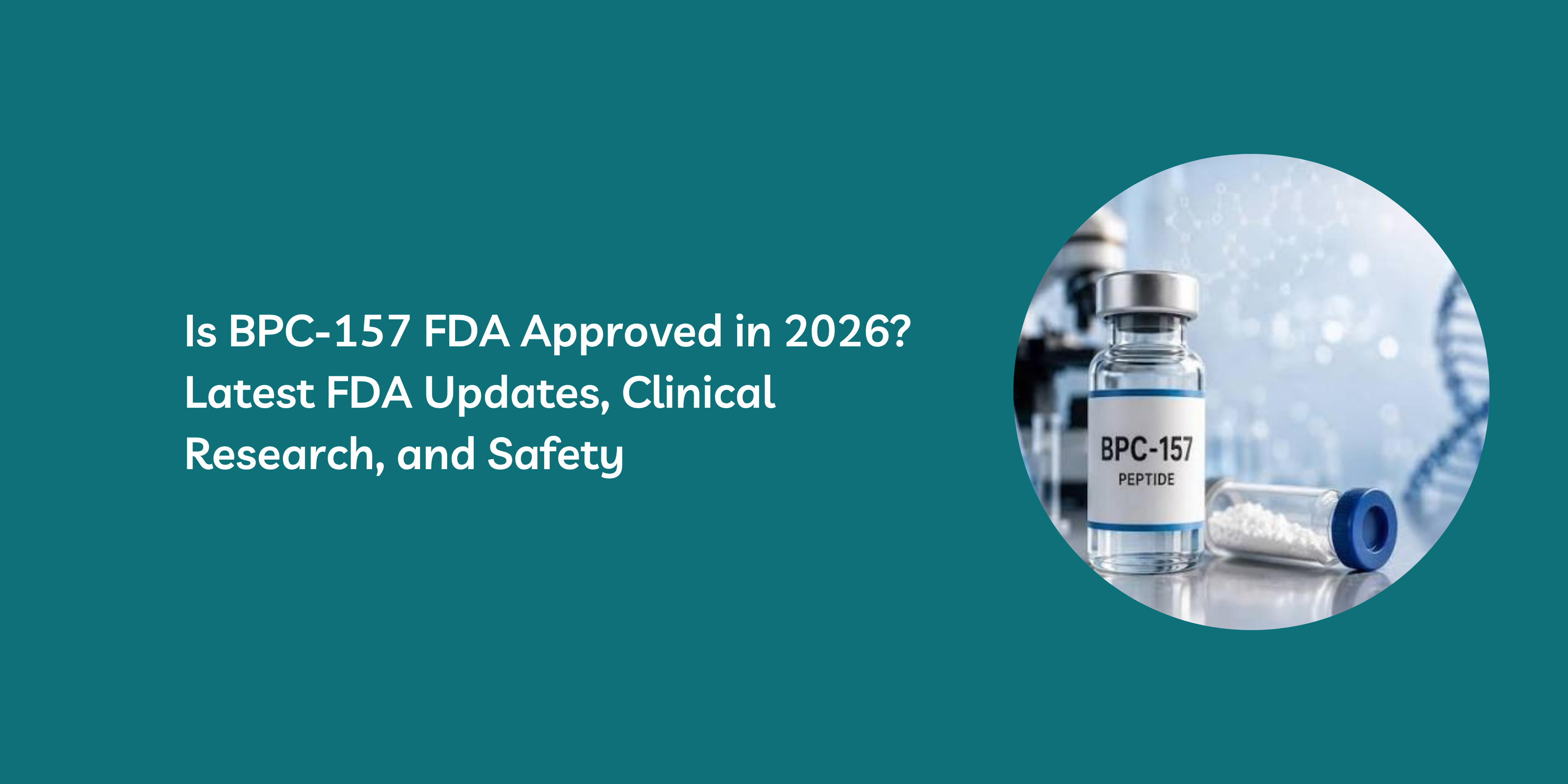
BPC-157, short for Body Protection Compound 157, is a synthetic peptide consisting of 15 amino acids. Researchers have investigated it primarily in laboratory and animal studies examining biological processes associated with tissue repair, inflammation, and blood vessel formation.
These findings have generated interest in its possible therapeutic applications. However, results from laboratory experiments or animal models cannot establish that the same effects will occur in humans.
Two forms considered in the FDA's 2026 compounding review were BPC-157 free base and BPC-157 acetate. Although these forms relate to the same peptide, the FDA evaluated them as separate bulk drug substance nominations.
It is important to distinguish scientific investigation from established medical use. BPC-157 remains investigational and does not have an FDA-approved therapeutic indication.
Is BPC-157 FDA Approved in 2026?
No. BPC-157 is not FDA approved for human therapeutic use as of October 2026.
The FDA's review materials indicate that BPC-157 has not been approved as a finished drug product. The agency has also identified insufficient safety information for certain proposed routes of administration.
FDA approval generally requires an appropriate application supported by evidence addressing a medicine's safety and effectiveness for its intended use. A substance being discussed by an advisory committee or studied in a clinical trial does not meet that requirement by itself.
The distinction matters because online discussions sometimes describe BPC-157 as an approved treatment for injury recovery, tendon problems, or gastrointestinal conditions. Those descriptions should not be interpreted as established FDA-approved indications.
Current Regulatory Status :
Regulatory Question | Status as of October 2026 |
Is BPC-157 FDA approved? | No |
Does it have an FDA-approved therapeutic indication? | No |
Has the FDA identified safety concerns regarding compounded BPC-157? | Yes |
Did the July 2026 advisory committee recommend it for the 503A Bulk Drug Substances List? | Yes |
Does that recommendation itself authorize compounding? | No |
Has the recommendation established clinical safety and effectiveness? | No |
The approval question is separate from whether future regulatory action might permit certain forms of compounding under specific conditions.
What Did the FDA Say About BPC-157 Safety?
The FDA has identified several concerns regarding compounded drug products containing BPC-157.
These include:
Potential immunogenicity: The possibility that a substance or its impurities could trigger an immune response.
Peptide-related impurities: Unwanted substances associated with peptide manufacturing that may affect product quality or safety.
Active ingredient characterization: Challenges in adequately identifying and characterizing the substance used in a compounded product.
Limited safety information: Insufficient evidence to determine whether certain proposed routes of administration could cause harm in humans.
These concerns do not establish that every possible exposure will produce the same outcome. They do, however, highlight why adequate quality, safety, and clinical evidence are important before a compound is used as a medical treatment.
The FDA's assessment is particularly relevant when a product is promoted for routes of administration for which reliable human safety information is limited.
July 2026 FDA Advisory Committee Update
One of the major developments in BPC-157's regulatory history occurred on July 23, 2026.
The FDA's Pharmacy Compounding Advisory Committee, commonly known as PCAC, considered whether BPC-157 free base and BPC-157 acetate should be added to the Section 503A Bulk Drug Substances List.
According to the reported vote, the committee recommended inclusion by 8 votes to 6, with one abstention.
This recommendation attracted attention because it could influence future discussions about the circumstances under which certain pharmacies might compound the substance.
However, the vote needs to be interpreted in its proper regulatory context.
What Does a PCAC Recommendation Mean?
PCAC advises the FDA on matters related to pharmacy compounding. Its recommendations inform the agency's decision-making but are not equivalent to final FDA determinations.
The July vote addressed the possible inclusion of BPC-157 bulk substances on a compounding list. It did not establish that BPC-157 had met the requirements for approval as a finished medicine.
The FDA's briefing materials also discussed limitations in the available evidence, including the small amount of human safety information.
Does the Vote Mean BPC-157 Is Now FDA Approved?
No.
A recommendation concerning the 503A Bulk Drug Substances List is different from approval of a new drug application.
The recommendation itself does not:
Approve BPC-157 to treat a medical condition.
Establish that the compound is safe or effective.
Validate claims about injury recovery or tissue repair.
Automatically authorize pharmacies to compound it.
Establish that products sold online meet pharmaceutical quality standards.
Any subsequent change to compounding eligibility would need to be evaluated separately from FDA drug approval.
Regulatory status note: The July 2026 vote is documented in FDA meeting materials. The latest status of any subsequent formal listing or rulemaking should be checked against the FDA's current records before publication.
BPC-157 and Human Clinical Research
An important limitation in evaluating BPC-157 is the gap between preclinical interest and reliable human evidence.
Laboratory and animal research can help scientists investigate biological mechanisms and identify questions for further study. It cannot, by itself, demonstrate that a compound safely treats a medical condition in people.
The FDA's 2026 briefing materials discussed a limited number of human studies, including research involving rectal administration in healthy volunteers and people with ulcerative colitis. The available evidence is not sufficient to establish BPC-157 as an effective treatment for ulcerative colitis or other conditions.
The agency also noted gaps in safety information for certain proposed routes of administration.
A Clinical Trial Registered in 2026
ClinicalTrials.gov lists a Phase 2 study titled BPC 157 for Acute Hamstring Muscle Strain Repair, registered under identifier NCT07437547.
The study record describes a randomized, double-blind, placebo-controlled trial investigating BPC-157 in adults with an acute grade II hamstring strain. Participants receive the study intervention or placebo alongside a standardized rehabilitation program.
The registry lists the study start date as February 2, 2026, and the estimated primary completion date as February 14, 2027.
Importantly, the registry states that the study is not studying a U.S. FDA-regulated drug product.
The study's existence does not demonstrate that BPC-157 works. Its purpose is to investigate research questions that remain unresolved.
What Can Be Concluded From Current Research?
At present, the available evidence does not establish BPC-157 as a proven treatment for:
Tendon or ligament injuries.
Muscle injuries or accelerated recovery.
Ulcerative colitis or other digestive disorders.
General tissue repair.
Other conditions promoted in online discussions.
These are areas in which further evidence would be needed to determine whether potential benefits exist and whether those benefits outweigh the risks.
BPC-157 Approval vs. Pharmacy Compounding
The terms FDA approved and compounded describe different regulatory concepts.
FDA-Approved Medicines
An FDA-approved drug has received authorization for specified uses based on the applicable regulatory review.
Approval applies to the particular product and its approved indications. It does not automatically extend to other products containing a similar substance.
Compounded Medicines
Compounding involves preparing a medication for a particular patient or other permitted circumstances under applicable legal requirements.
Some compounded medications may be prepared under federal exemptions when the relevant conditions are satisfied. These exemptions do not mean that the resulting product has undergone the same FDA approval process as an approved drug.
For BPC-157, a favorable advisory committee recommendation does not by itself establish eligibility for compounding. The applicable FDA determination and other legal requirements must be considered.
Research Compounds
A research compound may be investigated in laboratory experiments or clinical research without being an FDA-approved medicine.
Its availability for research does not establish that it is appropriate for self-treatment or that products sold under a research-use label have been evaluated for human use.
These distinctions are essential when interpreting claims about BPC-157's regulatory status.
Why Online Claims About BPC-157 Require Caution
BPC-157 is frequently discussed online in connection with tissue repair, recovery, inflammation, and gastrointestinal health. However, the strength of those claims often exceeds what the available human evidence can establish.
Readers should be cautious about statements describing BPC-157 as an FDA-approved treatment or suggesting that the 2026 advisory committee vote proved its safety or effectiveness.
Terms such as research grade, laboratory tested, or high purity do not establish FDA approval. They also do not independently demonstrate that a product is suitable for human administration.
When evaluating health-related claims, it is important to distinguish published research findings from marketing statements and established clinical evidence.
Frequently Asked Questions
Is BPC-157 FDA approved in 2026?
No. As of October 2026, BPC-157 is not an FDA-approved drug for any therapeutic indication.
What happened at the July 2026 FDA advisory committee meeting?
The Pharmacy Compounding Advisory Committee recommended adding BPC-157 free base and BPC-157 acetate to the Section 503A Bulk Drug Substances List. The reported vote was 8–6, with one abstention. The recommendation was not FDA drug approval.
Does the PCAC vote prove that BPC-157 is safe?
No. An advisory committee recommendation does not establish safety or effectiveness. The FDA has identified important limitations in the available safety information for compounded BPC-157 products.
Is BPC-157 proven to help injuries heal?
No. Although preclinical research has investigated processes associated with tissue repair, reliable human evidence is insufficient to establish that BPC-157 safely and effectively treats injuries.
Are clinical trials studying BPC-157?
ClinicalTrials.gov lists a Phase 2 study investigating BPC-157 for acute hamstring muscle strain. The study's existence does not establish a treatment benefit, and its registry record states that it is not studying a U.S. FDA-regulated drug product.
Is a compounded product the same as an FDA-approved drug?
No. Compounding and FDA drug approval are separate regulatory pathways. A compounded medication is not automatically FDA approved, even when its ingredients are being evaluated for possible inclusion on a compounding list.
Has BPC-157 received approval for ulcerative colitis?
No. The FDA reviewed evidence related to ulcerative colitis in connection with the compounding-list evaluation, but that review did not establish BPC-157 as an FDA-approved treatment for the condition.
Conclusion: What Is BPC-157's FDA Status?
As of October 2026, BPC-157 remains an investigational peptide without FDA approval for a medical condition.
The July 2026 PCAC recommendation was a notable regulatory development, but it concerned potential eligibility for a particular pharmacy-compounding pathway—not approval of a finished drug product.
Meanwhile, the available human evidence remains limited, and the FDA has identified concerns involving immunogenicity, peptide impurities, ingredient characterization, and insufficient safety information for proposed routes of administration.
For readers, researchers, and healthcare professionals, the central distinction is straightforward: scientific interest, a clinical trial, and a compounding recommendation do not establish that a medicine is FDA approved or proven safe and effective.
For the most current assessment, consult the FDA's official records and the latest clinical-trial registry information rather than relying on marketing claims or generalized descriptions of peptide status.
Disclaimer: This article is for educational purposes only. It does not provide medical advice or establish the safety or effectiveness of BPC-157 for any condition. Regulatory information may change, so readers should consult current official records for updates.
Reference :
FDA Pharmacy Compounding Advisory Committee meeting materials (July 23, 2026): https://www.fda.gov/media/193773/download
BPC-157 in Rodent Ischemia–Reperfusion Injury: A Critical Review (PMC): https://pmc.ncbi.nlm.nih.gov/articles/PMC13607336/
BPC-157 as an Investigational Peptide Therapeutic (PMC): https://pmc.ncbi.nlm.nih.gov/articles/PMC13210877/
Access without approval: state-level determinants of peptide use (PMC): https://pmc.ncbi.nlm.nih.gov/articles/PMC13326628/
FDA panel recommends easing restrictions on several peptides, including BPC-157: https://ground.news/article/fda-panel-recommends-easing-restrictions-on-several-peptides-including-bpc-157
BPC-157 FDA Approval Status 2026: Clinical Trials: https://peptidestack.io/blog/bpc-157-fda-approval-status
Peptide Dangers Result in Hospitalizations: https://www.yahoo.com/news/science/articles/peptide-dangers-result-hospitalizations-204848617.html