
How Long Does Bacteriostatic Water Last with Peptides? A Practical Research Guide
When working with peptides in a research setting, storage and handling can be just as important as selecting the right compound. A peptide may be carefully sourced and properly prepared, but poor storage conditions, repeated vial access, temperature changes, or contamination can affect its quality.
This is where Advanced Peptide Research requires more than simply knowing when a vial expires. Researchers need to understand the difference between bacteriostatic water, the peptide itself, and the reconstituted solution. One of the most common misconceptions is that bacteriostatic water automatically keeps a reconstituted peptide stable for 28 days. The 28-day figure generally relates to the use of an opened multidose vial under specified conditions, while the stability of an individual peptide depends on its own chemical properties and available stability data.
What Is Bacteriostatic Water?
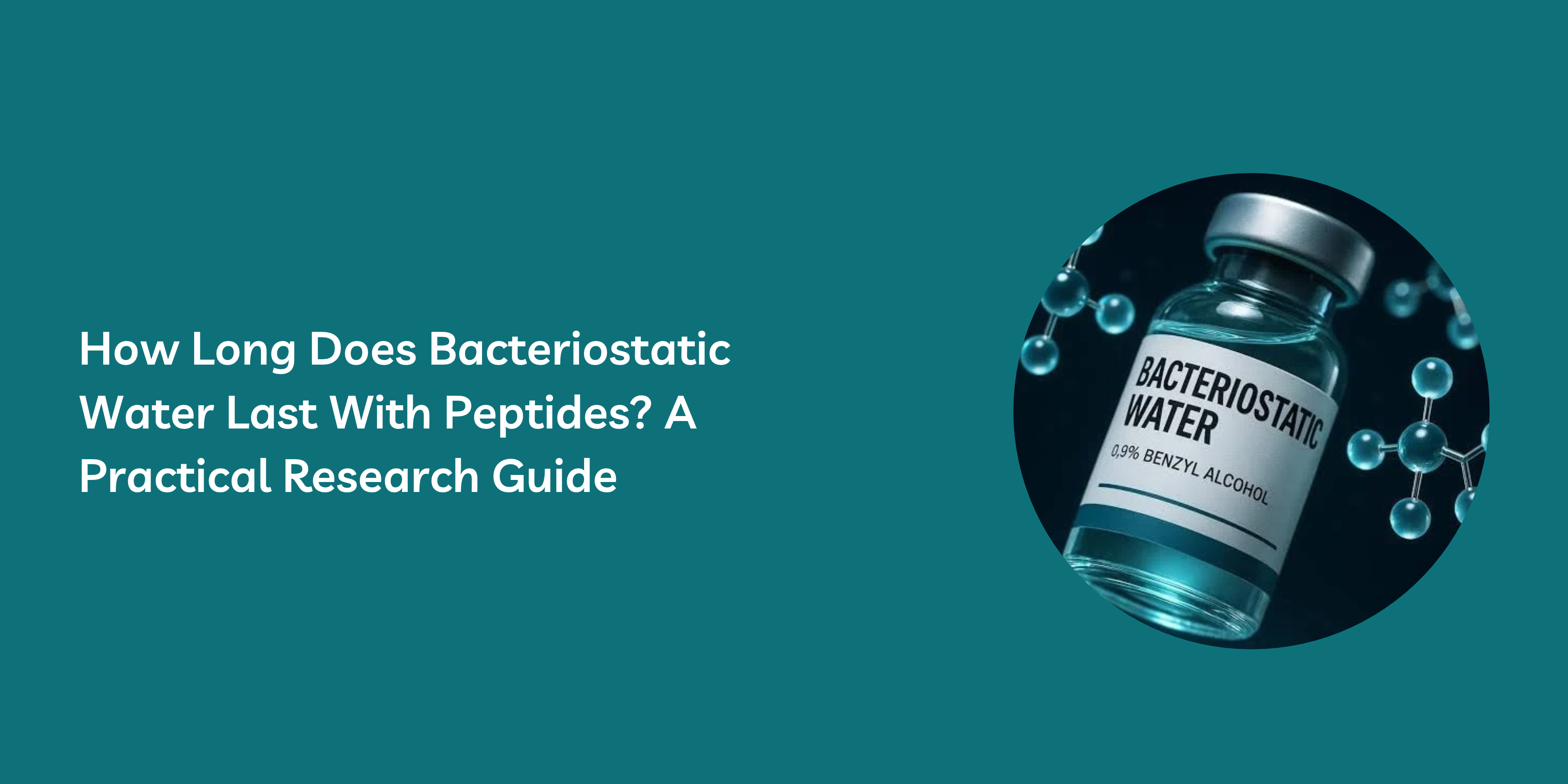
Bacteriostatic water for injection is sterile water containing a small amount of an antimicrobial preservative, commonly benzyl alcohol. The preservative helps inhibit the growth of bacteria when a properly labeled multidose vial is accessed repeatedly.
The word “bacteriostatic” is important. It means that bacterial growth is inhibited; it does not mean that the solution can sterilize contaminated materials.
This distinction matters when handling research materials. Once contamination has entered a vial, the preservative should not be treated as a guarantee of safety. Proper aseptic handling and following the manufacturer's storage and use instructions remain essential.
The CDC notes that preservatives in multidose vials can help limit bacterial growth but do not provide complete protection against contamination.
How Long Does Bacteriostatic Water Last?
The answer depends on whether the vial has been opened.
Unopened Bacteriostatic Water
An unopened vial should generally be used according to the expiration date printed by the manufacturer and stored under the conditions specified on its label.
The commonly referenced shelf life for unopened products can extend for years, but there is no universal expiration period that applies to every product. Temperature, packaging, formulation, manufacturing specifications, and storage conditions calif shelfct the actual shelf life.
Always prioritize the manufacturer's labeled expiration date over a generic timeline.
Opened Bacteriostatic Water
The frequently cited 28-day period applies to many opened multidose vials. CDC guidance states that an opened multidose vial should generally be dated and discarded within 28 days unless the manufacturer provides a different timeframe.
This does not mean every bacteriostatic-water product automatically has the same 28-day limit. The product label and applicable professional guidance should take priority.
Once a vial has passed its applicable beyond-use period, keeping it refrigerated does not automatically restore its original quality.
Does Bacteriostatic Water Keep a Reconstituted Peptide Stable for 28 Days?
This is one of the biggest points of confusion.
No universal 28-day stability rule applies to all reconstituted peptides.
The 28-day timeframe concerns the opened multidose vial and its preservative system. A peptide dissolved in that water becomes a different preparation with its own stability considerations.
Peptides can be affected by several degradation pathways, including oxidation, hydrolysis, aggregation, temperature exposure, and changes in pH. Some compounds may remain relatively stable under appropriate conditions, while others may degrade much more quickly.
Therefore, the stability of a reconstituted peptide should be determined from compound-specific stability information whenever available rather than assuming that the bacteriostatic-water timeline applies automatically.
Why Temperature Matters
Temperature is one of the easiest storage variables to overlook.
Higher temperatures can accelerate chemical reactions and may contribute to degradation of sensitive compounds. Refrigeration can slow certain degradation processes, but simply placing a vial in a refrigerator does not guarantee long-term stability.
Avoid repeatedly moving materials between cold and warm environments. Temperature fluctuations can be more problematic than maintaining a consistently appropriate storage condition.
For any research material, the first reference should be the product's documented storage requirements. If a manufacturer or qualified laboratory provides a specific temperature range, follow that information rather than relying on a general peptide-storage rule.
Protect Peptides from Light and Excessive Handling
Light exposure is another consideration for sensitive compounds. Some chemical components can undergo degradation when exposed to light for extended periods.
Keeping vials in their original packaging or another appropriate light-protective environment can reduce unnecessary exposure.
Repeated handling also increases opportunities for contamination. Every time a vial is accessed, there is another opportunity for environmental contaminants to reach the contents. Using appropriate sterile technique and minimizing unnecessary vial access are therefore important parts of good research practice.
A clear solution should not automatically be considered sterile or chemically intact. Visual inspection can identify obvious problems such as cloudiness, unexpected particles, or discoloration, but it cannot confirm sterility or prove that a peptide has retained its full chemical integrity.
Practical Storage Tips for Peptide Researchers
Good storage practices do not have to be complicated. A consistent routine can prevent many avoidable problems.
1. Record the date a multidose vial is first accessed
Write down the date of first puncture and follow the applicable beyond-use period. This prevents the common mistake of relying on memory.
2. Keep storage conditions consistent
Avoid unnecessary temperature swings. Store materials according to the manufacturer's instructions rather than moving them repeatedly between storage locations.
3. Keep materials protected from unnecessary light
If the product documentation recommends protection from light, keep the vial in its original packaging or another suitable protective environment.
4. Use clean, appropriate handling procedures
Each access should use sterile equipment and appropriate aseptic technique. Never assume that a preservative makes careless handling acceptable.
5. Separate expiration from stability
The expiration date of the water does not establish the stability period of a peptide after reconstitution. These are two separate questions.
6. Do not rely only on appearance
A clear solution may still have contamination or chemical degradation that cannot be detected visually. When quality is uncertain, documented testing or professional guidance is more reliable than appearance alone.
Choosing Reliable Research Information
Researchers also need to consider the quality of information surrounding a peptide product. A useful Peptide Vendor Directory can make comparisons easier by bringing together information such as product documentation, available testing records, research-use labeling, and other relevant supplier details.
However, a directory should be treated as a starting point rather than a substitute for independent verification. Look for transparent product information, batch documentation where available, clearly stated storage requirements, and accessible laboratory or quality-control information.
It is also helpful to compare information across multiple sources rather than accepting a single claim about shelf life or stability. Research-oriented buyers should pay particular attention to whether the claimed storage period is supported by actual stability data or is simply a generalized recommendation.
Getting Better Value Without Sacrificing Quality
Price can be an important consideration when purchasing research materials, particularly for laboratories comparing multiple compounds or suppliers. However, the lowest listed price is not necessarily the best overall value.
When evaluating Research Peptide Discounts, compare the complete picture rather than looking only at the advertised price. Consider product documentation, testing information, batch consistency, packaging, shipping conditions, and the supplier's transparency.
A slightly higher-cost product with stronger documentation may provide more useful research value than a cheaper option with limited information. Buyers should also be cautious of unusually large discounts that come with unclear specifications or questionable quality documentation.
The goal should be a sensible balance between cost, transparency, documentation, and research requirements.
Conclusion
Understanding how bacteriostatic water interacts with peptide storage starts with separating two different concepts: the usable period of the opened water vial and the stability of the peptide after reconstitution.
The often-mentioned 28-day timeframe can be relevant to open multidose vials when the applicable product guidance supports it, but it should not be treated as a universal stability guarantee for every reconstituted peptide.
For better research practices, keep accurate opening dates, follow labeled storage requirements, minimize contamination risks, protect sensitive materials from unnecessary environmental exposure, and use peptide-specific stability information whenever it is available.
Most importantly, avoid assumptions. A peptide's quality cannot be determined simply by looking at a vial or applying a generic storage timeline. Careful documentation, reliable sourcing, appropriate handling, and evidence-based storage decisions provide a much stronger foundation for responsible peptide research.
Similar Blog Posts
All articles
9/28/2026
AHK-Cu and Hair Follicles: Exploring the Science Behind Copper Peptides
Explore AHK-Cu and its potential role in hair follicle research. Learn how this copper peptide has been studied in dermal papilla cells, follicle growth, cellular signaling, VEGF pathways, and skin biology while understanding the limits of current laboratory evidence.
Read Article
9/22/2026
BPC-157 Research Guide: Structure, Applications, Storage & Quality Considerations
Explore BPC-157 research, molecular structure, preclinical applications, storage considerations, and product quality factors. Learn how researchers evaluate testing, documentation, purity, and research materials while understanding the current limitations of human evidence.
Read Article
9/7/2026