
Selank vs Semax: A Complete Comparison of Mechanisms, Benefits, Evidence, and Differences
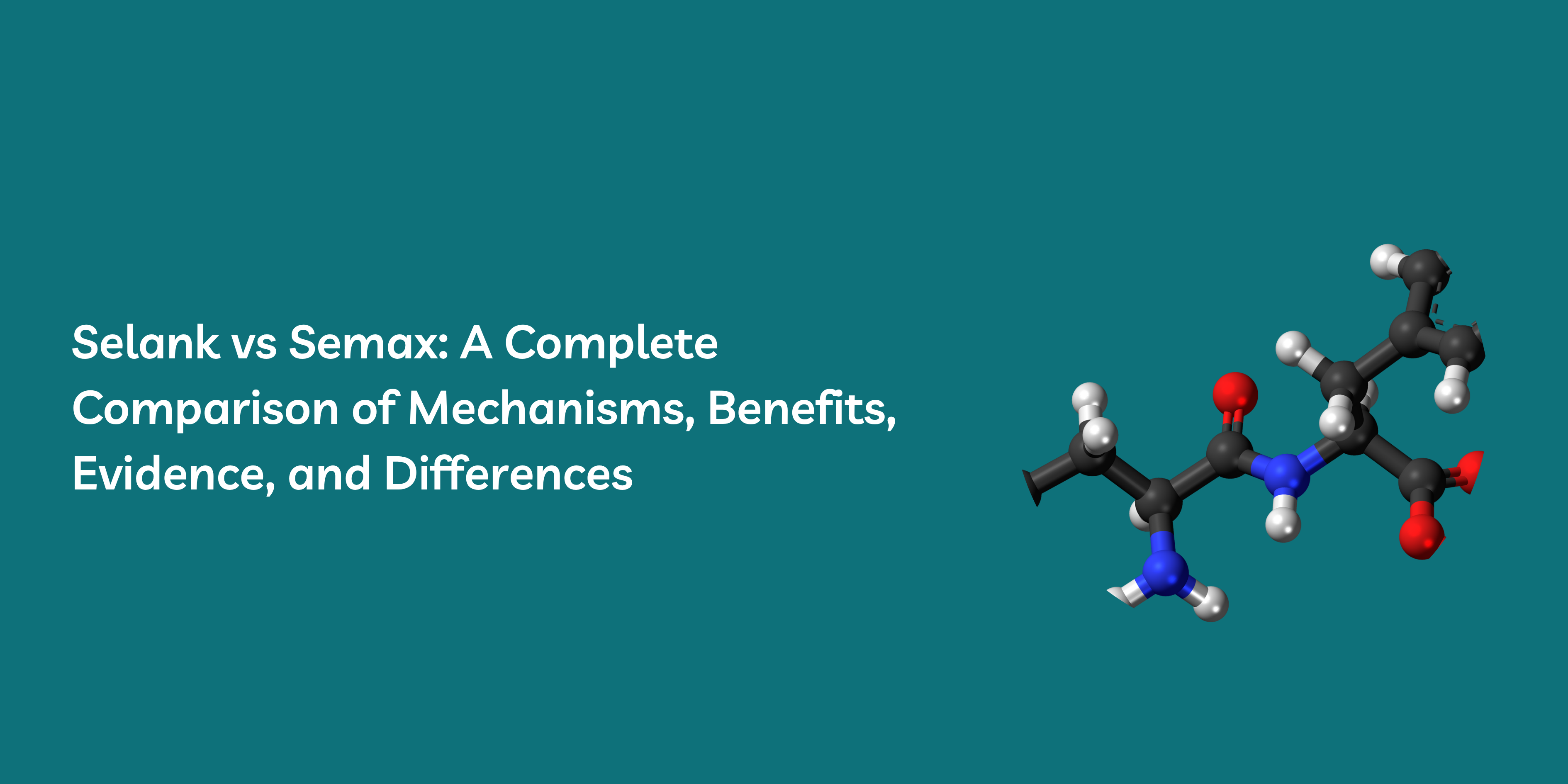
Selank and Semax are two experimental neuroactive peptides that have gained attention for their potential effects on anxiety, cognition, memory, and brain health. Both compounds originated from Russian research programs and are often grouped together as “nootropic peptides,” but their biological targets and proposed applications are quite different.
Selank was primarily developed as an anxiolytic and immunomodulatory peptide, while Semax was designed around cognitive enhancement and neuroprotective effects. Although both compounds influence brain signaling pathways, the quality of evidence behind their reported benefits remains limited compared with approved medications.
This comparison examines the chemistry, mechanisms, available research, differences, safety considerations, and practical factors that separate Selank from Semax.
What Are Selank and Semax?
Although both compounds contain seven amino acids, their structures and origins are different.
Selank: The Anxiolytic Peptide
Selank is a synthetic heptapeptide with the sequence:
Thr-Lys-Pro-Arg-Pro-Gly-Pro
It was developed by researchers at the Institute of Molecular Genetics of the Russian Academy of Sciences by modifying tuftsin, an endogenous peptide fragment derived from immunoglobulin G.
Tuftsin naturally participates in immune regulation and has mild effects on stress-related pathways. Scientists extended its structure with a Pro-Gly-Pro sequence to improve stability and create Selank.
Unlike traditional anti-anxiety medications, Selank is believed to influence anxiety pathways without causing strong sedation.
Its proposed actions include:
Modulation of GABA-related signaling
Regulation of serotonin pathways
Increased expression of neurotrophic factors
Immunological effects involving T-cell activity
Semax: The Cognitive Peptide
Semax is also a seven-amino-acid peptide:
Met-Glu-His-Phe-Pro-Gly-Pro
It was developed from the ACTH(4-10) fragment, a portion of adrenocorticotropic hormone associated with cognitive and neuroprotective activity.
Despite being derived from ACTH, Semax does not appear to stimulate cortisol production because the ACTH fragment lacks the receptor-binding structure required for adrenal activation.
A modified version known as N-acetyl Semax amidate adds chemical modifications intended to improve stability and potency. However, direct human comparisons between standard Semax and modified versions remain limited.
How Selank Works in the Brain
Selank primarily affects systems involved in anxiety regulation and emotional balance.
GABA and Stress Response
Research suggests Selank interacts with GABA-A receptor pathways, which are involved in calming neural activity.
Animal studies conducted by Russian researchers found that Selank influenced genes associated with:
GABA neurotransmission
Serotonin signaling
Stress response pathways
A 2011 study examining gene expression changes in rats reported alterations in more than 80 genes after Selank administration, including pathways related to emotional regulation.
Effects on BDNF and Enkephalin
Selank has also been linked with increased brain-derived neurotrophic factor (BDNF) activity in animal studies.
BDNF plays an important role in:
Neural adaptation
Learning
Memory formation
Another proposed mechanism involves inhibition of enkephalin-degrading enzymes, potentially allowing longer activity of natural opioid-like peptides involved in mood regulation.
Immunological Effects
One major difference between Selank and Semax is Selank’s immune-related activity.
Research has reported effects on:
Interleukin-2 production
T-cell function
Immune regulation
This immunomodulatory role was part of the original reason Selank was developed.
How Semax Works in the Brain
Semax is primarily studied for cognitive and neuroprotective effects.
BDNF and Neural Plasticity
The main proposed mechanism involves increasing neurotrophic signaling.
Animal research has shown that Semax may increase:
BDNF expression
NGF activity
MAPK/ERK pathway signaling
These pathways are associated with:
Synaptic communication
Learning processes
Brain adaptation
One rodent study reported increased BDNF protein levels in the cortex after Semax administration, although the exact effect size varies between studies.
Dopamine and Serotonin Modulation
Semax may also influence neurotransmitter systems involved in:
Attention
Motivation
Mood regulation
Additionally, research has examined its role in nitric oxide pathways, particularly in models studying brain blood flow and ischemic injury.
However, increased BDNF activity in animal models does not automatically prove meaningful cognitive improvements in humans.
Selank vs Semax: Evidence Comparison
The biggest difference between these peptides is not only their mechanisms but also their intended use.
Area
Selank
Semax
Primary focus
Anxiety regulation and immune modulation
Cognition and neuroprotection
Main pathway
GABA, serotonin, BDNF
BDNF, NGF, MAPK/ERK
Human evidence
Small Russian clinical studies
Small Russian clinical studies
Strongest research area
Anxiety symptoms
Cognitive recovery and attention
Long-term safety data
Limited
Limited
What Does the Research Actually Show?
Selank Evidence
Clinical studies from Russia suggest Selank may reduce anxiety symptoms.
Reported findings include:
Improvement in anxiety rating scores
Reduced stress-related symptoms
Possible mood stabilization
However, limitations include:
Small participant groups
Limited independent replication
Lack of large Western clinical trials
Semax Evidence
Semax has been studied more extensively in neurological conditions such as stroke recovery.
Research has reported possible improvements in:
Attention
Memory performance
Cognitive recovery
Animal models also suggest neuroprotective effects during brain injury.
However, evidence remains limited because most studies are small and geographically concentrated.
Selank vs Semax vs Approved Alternatives
Feature
Selank
Semax
Buspirone
Modafinil
Main purpose
Anxiety support
Cognitive enhancement
Anxiety treatment
Wakefulness
Approval status
Russia only
Russia only
FDA-approved
FDA-approved
Human evidence
Limited
Limited
Strong
Strong
Long-term safety data
Limited
Limited
Extensive
Extensive
Dependence risk
Not reported
Not reported
Low
Low to moderate
Approved medications have significantly stronger clinical evidence because they have undergone larger controlled trials.
Typical Research Doses
The doses reported in scientific literature vary depending on the study.
Selank
Research protocols commonly describe:
Intranasal administration
Approximately 250–300 mcg per nostril
Multiple daily administrations
Treatment periods ranging from one to two weeks
Semax
Reported research ranges include:
Lower doses around 200–600 mcg daily for cognitive studies
Higher doses in neurological research settings
Modified versions such as N-acetyl Semax amidate are believed to be more potent, but reliable human dose comparisons are unavailable.
These amounts come from supervised research settings and should not be interpreted as personal treatment recommendations.
Common Misunderstandings About Selank and Semax
“They Have the Same Effects”
Although both are called nootropic peptides, their primary purposes differ.
Selank is more associated with:
Anxiety regulation
Stress response
Immune signaling
Semax is more associated with:
Cognitive pathways
Neuroprotection
Brain plasticity
“Semax Increases Cortisol Because It Comes From ACTH”
This is a common misconception.
Semax comes from an ACTH fragment that does not contain the receptor-binding region responsible for adrenal stimulation. Available studies do not show significant cortisol elevation at studied doses.
“Intranasal Means High Brain Availability”
The nasal route may allow some direct transport toward the central nervous system, but exact human bioavailability measurements remain unclear.
Mechanistically possible does not always mean clinically proven.
Stability and Storage Considerations
Both Selank and Semax are linear peptides and can degrade through chemical processes such as hydrolysis and oxidation.
Important factors affecting stability include:
Heat exposure
Moisture
Light exposure
Repeated temperature changes
Semax may be more vulnerable to oxidation because it contains methionine, which is sensitive to oxidative damage.
Signs of possible degradation may include:
Cloudiness
Visible particles
Color changes
Unexpected odor
Visual appearance alone cannot confirm peptide quality. Analytical testing is required for accurate evaluation.
How to Evaluate Peptide Quality
A reliable certificate of analysis (COA) should include:
Purity Testing
Look for:
HPLC purity results
Testing methodology
Actual chromatogram data
Identity Confirmation
Mass spectrometry should confirm that the compound matches the expected molecular structure.
Additional Quality Information
A strong COA should also include:
Batch or lot number
Water content
Endotoxin testing information
Independent laboratory verification
A certificate without traceable laboratory information provides limited confidence.
Potential Side Effects and Safety Questions
Available studies suggest both peptides are generally tolerated in short-term research settings.
Reported effects include:
Nasal irritation
Runny nose
Mild headache
Restlessness
Sleep disruption, especially with stimulating effects
Unlike benzodiazepines, Selank has not been strongly associated with sedation or dependence in available studies.
However, several important questions remain unanswered:
Long-term daily safety
Effects in healthy users
Medication interactions
Pregnancy safety
Effects in individuals with certain medical conditions
The absence of reported problems in small studies does not equal proof of long-term safety.
Which One Is Better: Selank or Semax?
The answer depends on the goal.
Selank May Be More Relevant For:
Stress-related symptoms
Anxiety-focused research
Emotional regulation pathways
Immune-related mechanisms
Semax May Be More Relevant For:
Cognitive research
Attention pathways
Neuroprotection studies
Brain recovery models
Neither peptide has enough high-quality evidence to replace approved treatments for anxiety disorders, cognitive impairment, or neurological disease.
Final Thoughts
Selank and Semax represent two interesting areas of peptide neuroscience research. While both compounds show promising mechanisms involving neurotransmitters and neurotrophic factors, the current evidence is still limited by small studies, lack of independent replication, and insufficient long-term safety data.
Selank stands out for its anxiety-related and immunomodulatory research, while Semax has attracted more attention for cognitive and neuroprotective applications. Choosing between them depends largely on the specific goal being studied.
As research continues, larger controlled human trials will be necessary to determine whether these peptides can move from experimental compounds into widely accepted medical therapies.
Sources
Semenova TP, Kozlovskaya MM, Zakharova NM, et al. Selank affects the behavior and neurochemical processes in rats under experimental conditions. CNS Neuroscience and Therapeutics. 2011; cited for gene expression data and GABA modulation findings.
Dolotov OV, Karpenko EA, Inozemtseva LS, et al. Semax, an analog of ACTH(4-10) with cognitive effects, regulates BDNF and trkB expression in the rat hippocampus. Journal of Neurochemistry. 2006;97(Suppl 1):82-86.
Seredenin SB, Voronin MV. Neuroreceptor mechanisms of the selank anxiolytic effect. Eksperimental'naia i Klinicheskaia Farmakologiia. 2009;72(4):6-10. [Article in Russian, cited for receptor mechanism data.]
Grivennikov IA. Semax, a synthetic peptide with effects on cognitive function. Molecular Biology (Moscow). 2008;42(2):236-245. [Cited for BDNF upregulation data and mechanism overview.]
Miasoedov NF, Skvortsova VI, Tvorogova TV, et al. Semax and its use in ischemic stroke (clinical study data). Zhurnal Nevrologii i Psikhiatrii imeni SS Korsakova. 1999. [Cited for stroke indication and dosing range.]
Ashmarin IP, Nezavibatko VN, Miasoedov NF, et al. Design and investigation of an anxiolytic drug semax with no inhibitory effect. Zhurnal Vysshei Nervnoi Deiatel'nosti im IP Pavlova. 1997. [Cited for early characterization of semax and ACTH fragment pharmacology.]
Zozulya AA, Neznamov GG, Siuniakov TS, et al. Efficacy and possible mechanisms of the nootropic and anxiolytic effects of selank. Eksperimental'naia i Klinicheskaia Farmakologiia. 2008;71(4):2-11. [Cited for human anxiety trial data and Hamilton scale findings.]
Volkova A, Shadrina M, Kolomin T, et al. Selank peptide affects expression of enkephalin degrading enzymes in mouse brain. Advances in Bioscience and Biotechnology. 2012;3:1228-1233.
Similar Blog Posts
All articles
9/7/2026
How to Evaluate Peptide Vendors and Avoid Common Red Flags
Read Article
9/7/2026
How to Choose a Reliable Research Peptide Vendor: A Complete Guide to COAs, Lab Testing, and Transparency
Read Article
9/1/2026